What is Biohacking and why it's not a thing
Apr 29, 2026
Biohacking has moved from the margins of internet culture into the center of modern wellness, longevity, and preventive health conversations. Once associated with niche communities experimenting with fasting protocols, nootropics, sleep trackers, and cold plunges, it is now a broader consumer movement shaped by wearable technology, social media, personalised nutrition, digital biomarkers, and a growing desire for more control over health.
But biohacking is also a messy and ill-defined term. It covers everything from sensible lifestyle optimisation to expensive, unproven interventions. It can signal empowerment, but it can also obscure inequality, weak evidence, and the growing influence of charismatic personalities over qualified experts.
At Qina, we see biohacking not simply as a trend, but as a signal. It reflects a deeper shift in how people relate to their health, their identity and their values: from passive recipient to active participant with a strong awareness of their "why", from one-size fits all recommendations to personalised interventions; from reactive medicine to continuous monitoring and self-optimisation. The opportunity is real, but so are the risks. In this article we dive into the fascinating topic that has captured the aspirations of so many consumers.
Written by Mariette Abrahams PhD MBA & Stephanie Tucker RNutr
What is Biohacking?
Biohacking is the use of data, tools, routines, technologies, and biological interventions to improve health, performance, resilience, or longevity. In practice, it means people trying to “hack” their biology — to understand how their body works and then influence it in a more intentional way to improve their long-term health.
At the lighter end of the spectrum, biohacking includes practices such as improving sleep, timing exercise, tracking glucose, adjusting diet, meditating, or using specific or personalised supplements. At the more extreme end, it may include experimental therapies (think peptides, implantable devices, off-label drug use) or DIY biology.
What unites these practices is not a single technology, but a mindset: the belief that biology can be measured, influenced, and optimised.
How is biohacking different from traditional medical practice?
Traditional medicine is organised around diagnosis, treatment, safety, and evidence. It relies on professional training, clinical guidelines, regulatory oversight, and population-level research.
Biohacking is organised around experimentation, optimisation, and personal agency. It often begins outside the clinic, uses consumer tools rather than medical devices, and moves faster than formal evidence generation.
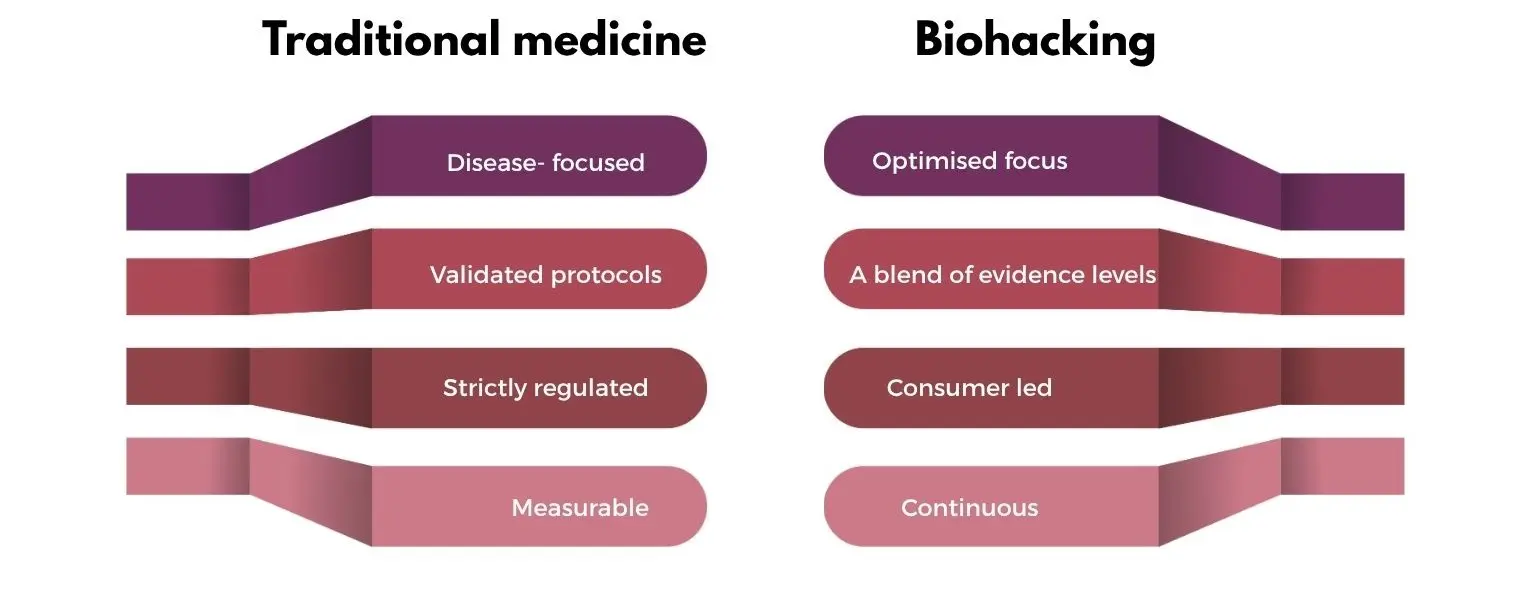
This does not mean one replaces the other. The most constructive future is likely a bridge: better consumer health tools, stronger evidence standards, expert interpretation, and interventions that connect everyday data with meaningful, clinically relevant support.
"But not every self-tracker is a biohacker"
What does Biohacking entail?
Biohacking is best understood as a spectrum rather than a single category. It often includes:
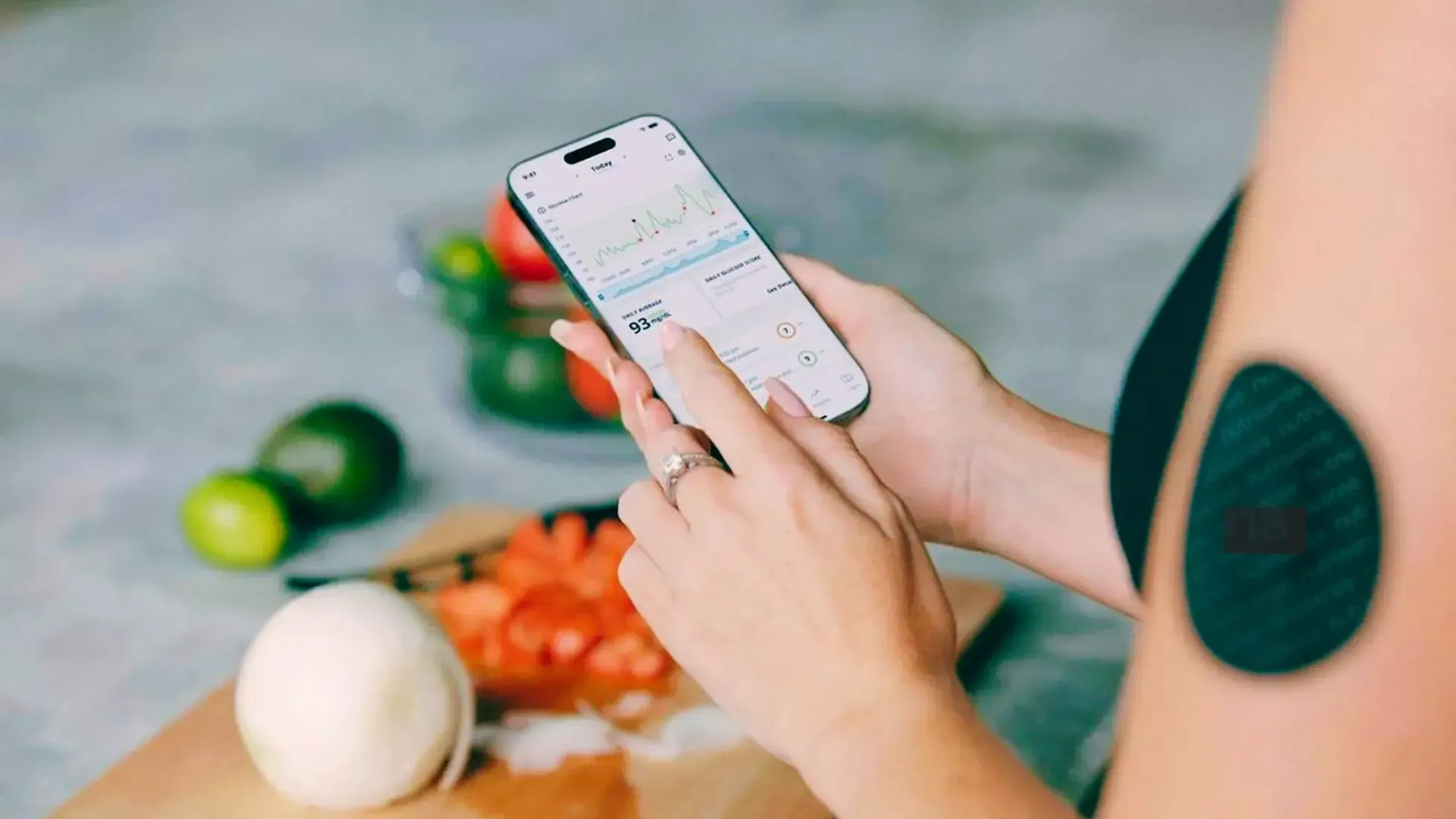
- Self-tracking: wearables, CGMs, sleep trackers, HRV monitors, microbiome tests, blood testing, and health apps.
- Lifestyle experimentation: intermittent fasting, cold exposure, light therapy, breathing practices, exercise programming, and sleep routines.
- Nutrition optimisation: elimination diets, personalised nutrition plans, supplement stacks, protein timing, glucose management, and gut-health interventions.
- Longevity practices: biological age testing, recovery technologies, peptide interest, and performance clinics.
Not all of these belong in the same risk category. Tracking sleep is not equivalent to self-administering an unregulated compound. Yet the language of biohacking often flattens those differences, which is one reason the term can be both useful and misleading.
In our Qina Engine, we have created a unique taxonomy to track the competitive landscape in personalised health based on a variety of factors such as technology, segment, channel. This makes it very easy to understand who is in the market as well as where they play from prevention to medical nutrition.
What are the growth drivers behind Biohacking?
Several forces are pushing biohacking into the mainstream.
Agency of own health
Consumers want more agency over their health. Many people feel that conventional healthcare is too reactive, too episodic, and too focused on disease rather than optimisation. Biohacking on the other hand appeals because it promises daily action, feedback, and a sense of control.
Accessible technology
Technology has made measurement easier and cost to access these technologies are dropping. Wearables, CGMs, at-home tests, AI-enabled coaching, and connected apps have turned health data into a consumer product. When people can see their sleep score, glucose curve, or readiness metric in real time, they are more likely to intervene.
Mental and Physical performance
Health has become a performance category. For many consumers, health is no longer just the absence of illness. It is energy, productivity, focus, appearance, resilience, and healthy ageing. Biohacking sits at the intersection of wellness, health and performance blending evidence-based medicine with eastern wellness approaches.
Social media
Social media has accelerated adoption. Platforms reward transformation stories, routines, hacks, and strong opinions. That makes biohacking highly shareable, but not always scientifically robust.
Spiralling chronic diseases
Finally, chronic disease and metabolic dysfunction are increasing. Rising rates of obesity, type 2 diabetes, poor sleep, stress, and burnout are creating demand for more preventive and personalised approaches. Biohacking markets itself as an answer to exactly those frustrations.
What is the size and evolution of the market?
The biohacking market is growing quickly, although exact numbers vary depending on what is included. Some market reports frame biohacking broadly enough to include wearables, supplements, nootropics, implants, mobile health tools, and preventive testing which makes the market look very large.
Grand View Research estimates the market at around $24.8 billion in 2024, rising to $69.1 billion by 2030. Precedence Research places it at $37.6 billion in 2025, while Mordor Intelligence estimates around $38.9 billion in 2026. The spread matters: it tells us that the market is real, but the definition is still unstable and highly fragmented.
Even so, the direction of travel is clear. What began as a niche movement around self-experimentation is becoming a broader commercial ecosystem made up of:
- wearable devices and biometric sensors
- personalised nutrition and supplement brands
- digital health platforms and coaching services
- longevity clinics and functional testing providers
- recovery and performance technologies
In essence, our view is that there is significant overlap between the Food Health ecosystem, Personalised Health and Longevity ecosystem. The evolution of the market has also been cultural. Biohacking used to appeal mostly to elite performers, fitness communities, and tech enthusiasts. Today it increasingly overlaps with mainstream healthy aging and consumer wellness. When most households are familiar with smartwatches, sleep scores, and health dashboards, the biohacking mindset no longer feels fringe it becomes routine, but does it?
"For many consumers, health is no longer just the absence of illness."
Which companies or influencers are driving the movement?
The movement is being disproportionately shaped by both businesses and media personalities.
On the company side, several categories stand out:
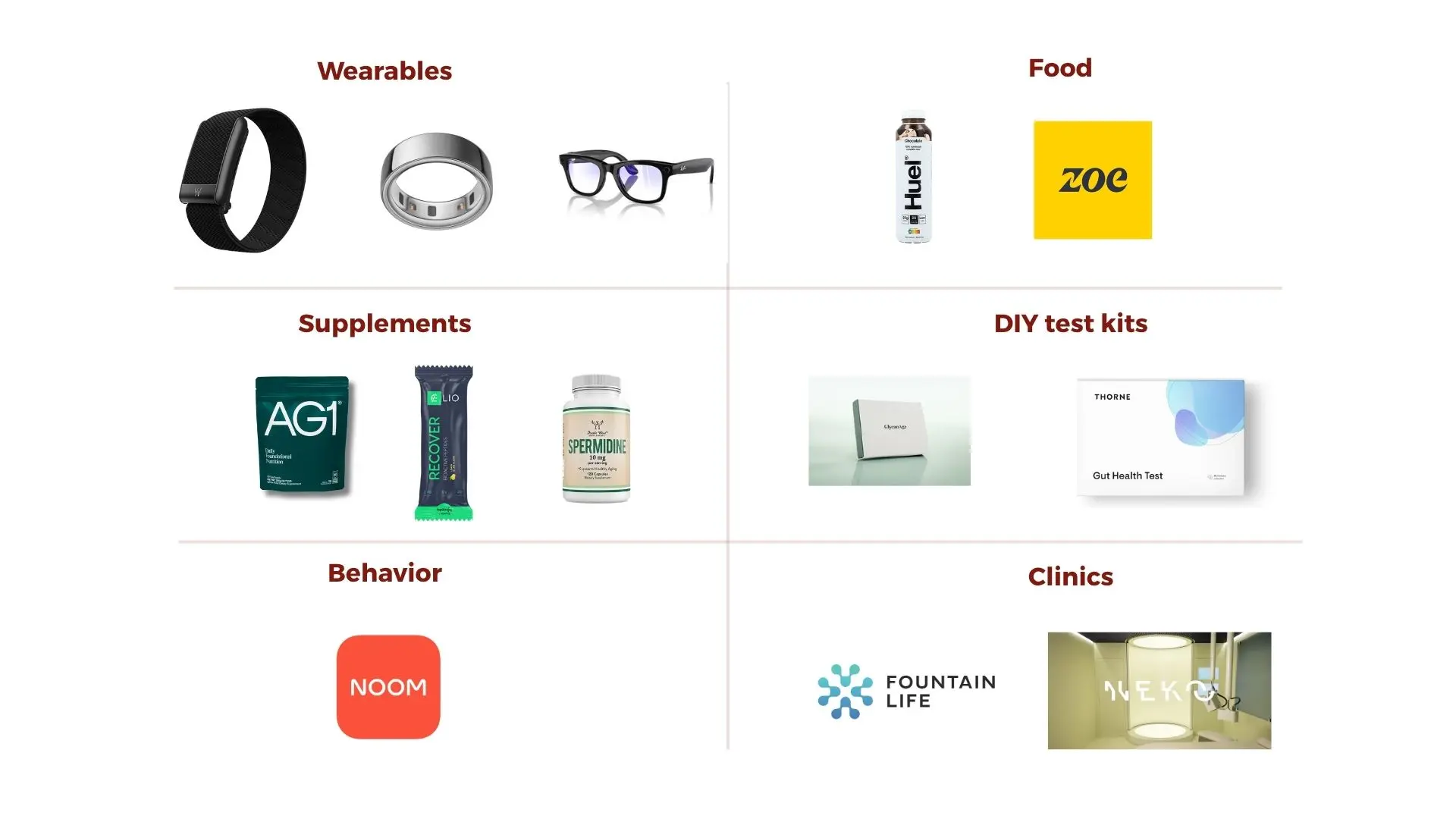
- wearables and sensor companies such as Oura, WHOOP, Garmin, Apple, Dexcom, Abbott, and Levels
- supplement and nootropic brands such as Bulletproof, AG1, Huel and a large ecosystem of performance nutrition brands
- longevity and optimisation clinics offering testing, recovery tools, and high-touch programmes such as FountainLife
- digital coaching platforms that turn data into advice or habit change such as Noom
On the influencer side, the field includes entrepreneurs, physicians, scientists, podcasters, athletes, and social-first personalities. Some of the most visible names associated with the broader movement include Dave Asprey, Ben Greenfield, Andrew Huberman, Mark Hyman, Brian Johnson and Wim Hof.
These figures do not all represent the same level of scientific rigour, and that distinction matters. Some translate emerging science responsibly. Others overstate certainty, market anecdote as evidence, or promote interventions that are commercially attractive but clinically underpowered.
This is one of the defining tensions in biohacking: attention is often driven by personality before it is earned by proof.
Who are the consumers that are engaging in Biohacking?
Biohacking consumers are more diverse than the stereotype suggests. It is no longer only affluent men in Silicon Valley testing edge-case interventions. Often biohacking consumers are interested in healthy aging, especially within younger generations as shown in a healthy ageing report by McKinsey in 2024 (below).
Key demographics in healthy ageing
Younger generations (Gen Z/millennials): They prioritize wellness, spend more on health tech like wearables, and focus on appearance, sleep, nutrition, and performance; 30% report ramping up wellness efforts recently (McKinsey 2024).
Older consumers (55+): 73% actively pursue longevity via preventative nutrition and science-backed tools, driving mainstream adoption.
Gender shift: Growing female interest in personalized, proactive health alongside men.
Motivations for a biohacking approach vary widely. Some want mental clarity. Some want better sleep. Some want to prevent future illness. Some are driven by productivity, aesthetics, or healthy ageing. Others are simply trying to feel better after years of generic advice that did not work for them.
However, participation is not evenly distributed. The more advanced or premium the tools become, the more the category skews toward affluent, highly educated, digitally connected consumers with time, money, and confidence to experiment. This coincides with much of what we see in Personalised nutrition.
What health benefits are consumers looking for when biohacking?
The stated purpose of biohacking is to help people function better for longer. Depending on the person, that may mean:
- improving energy, sleep, mood, or focus
- reducing glucose variability
- supporting fitness or recovery
- slowing biological ageing
- preventing disease through earlier signals and intervention
- feeling more in control of daily health decisions
At its best, biohacking reflects a positive shift toward proactive health management. It encourages curiosity, self-awareness, and engagement. It can help people notice patterns, change behaviours, and connect daily choices to biological outcomes.
At its most commercially inflated, however, the purpose shifts from better health to endless optimisation and data checking. That is where the category can become exhausting, exclusive, and vulnerable to hype.
What are the ethical and societal implications?
Biohacking raises broader questions that go beyond individual choice.
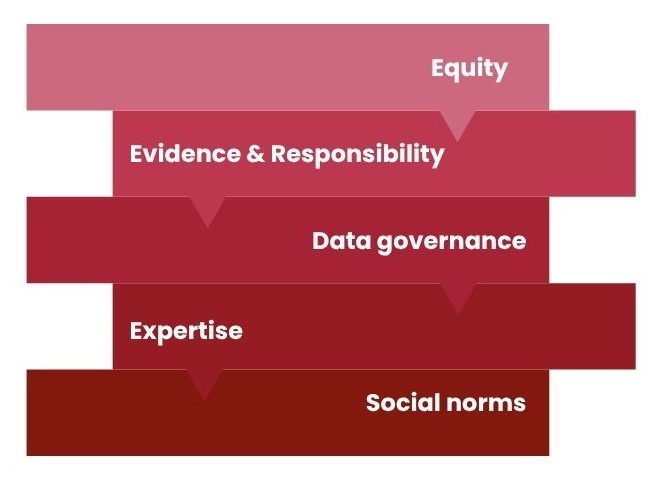
Equity - If better health increasingly depends on premium devices, private testing, subscriptions, and concierge guidance, then access becomes stratified. The people who are already healthiest and wealthiest may gain even more advantage, while underserved populations are left out of the conversation entirely.
Evidence and responsibility. When interventions spread faster than the science behind them, consumers absorb the risk. In digital health and nutrition, we should be especially cautious about overstating what biomarkers, apps, or single data streams can actually tell us and how reliable and trustworthy the data is.
Data governance. Biohacking runs on intimate biological data. That creates questions about privacy, ownership, interoperability, surveillance, and commercial use.
Expertise. Social media has flattened the distance between trained experts and persuasive content creators. In biohacking, visibility can be mistaken for authority. That has real consequences when consumers are making choices about supplements, fasting, medications, or restrictive protocols. It remains difficult for consumers to detect misinformation and disinformation.
Social norms. If optimisation becomes an expectation rather than a choice, people may feel moral pressure to constantly improve themselves. That can narrow our definition of health, turning it into a performance metric rather than a human experience shaped by environment, income, stress, care access, culture and community.
We must ensure the balance of innovation and personal optimisation against equity, evidence, data ethics and societal impact in the biohacking landscape.
The Qina perspective:
At Qina, our view is that biohacking captures an important truth which is that people want more personalised, preventive, and participatory health solutions. That instinct should not be dismissed. In essence, in our view there is significant overlap between the Food Health ecosystem, Personalised Health and Longevity ecosystem, but much of the market currently overpromises.
For Qina, the most credible future is not “hack your biology at any cost.” It is smarter, fairer, and more evidence-led personalisation.
Final thought
The winners in this space will not be the loudest brands or the most extreme influencers. They will be the organisations that can make personalised health more credible, more equitable, and more useful in everyday life.
That is where Qina sees the real future of the category.
To learn more about how we help brands and companies across Food, Health-tech, Ingredients and Consumer health industries innovate, click here