The Food Health ecosystem in pursuit of extended healthspan
Apr 17, 2026
The Food Health ecosystem has evolved over the past few years combining Food as Medicine, tech- enabled Personalised nutrition and MAHA initiatives all in one. The ultimate driver for this shift is the movement towards personalised health. This evolution has led to an increased awareness of the role of food in health and a focus on convenience, affordability and health equality. This article dives into this emerging topic, and what brands need to do to keep up.
Written by Mariette Abrahams PhD MBA
Background
The Personalised nutrition industry has focused on providing solutions across the spectrum from prevention to treatment also known as medical nutrition. As the industry evolved, it was clear that providing data alone was not sufficient to lead to lasting behavior change which meant that more companies started incorporating behavior change techniques, partnering with healthcare professionals and venturing outside of the traditional channels. Over the last few years, as retailers, farmers and retail outlets became increasingly involved, it shifted the dynamics from mass to personal right where consumers were already hanging out and looking for solutions. This coincided with the rapid rise in e-commerce, subscription business models and adoption of AI which made personalisation easier.
However, the industry does not stand still, and the evolution and pursuit of precision nutrition continues.
The Food Health ecosystem
The Food health ecosystem sits at the intersection of Food and Health with the goal to improve food literacy, nutritional status and equitably access to quality nutrition products and services.
Consumer interest increased for:
- more transparency with regards to food products and supplements
- higher nutrient density
- higher efficacy of ingredients (with proof)
- closer to real-food products
We have witnessed a blurring of the lines between Food, Health, Tech, Pharma and Societal impact. This has led to a proliferation of new solutions that have been reformulated, combined, revised or re-positioned to fit in with this shift. What the ecosystem thrives on ultimately is data. This drives personalisation but also proves health outcomes.
We can separate the industry as data generators ie companies or places where consumers/users share or generate personal, biological and lifestyle (shopping, exercise) data AND Data processors who analyze that data and provide solutions based on this data, see diagram below
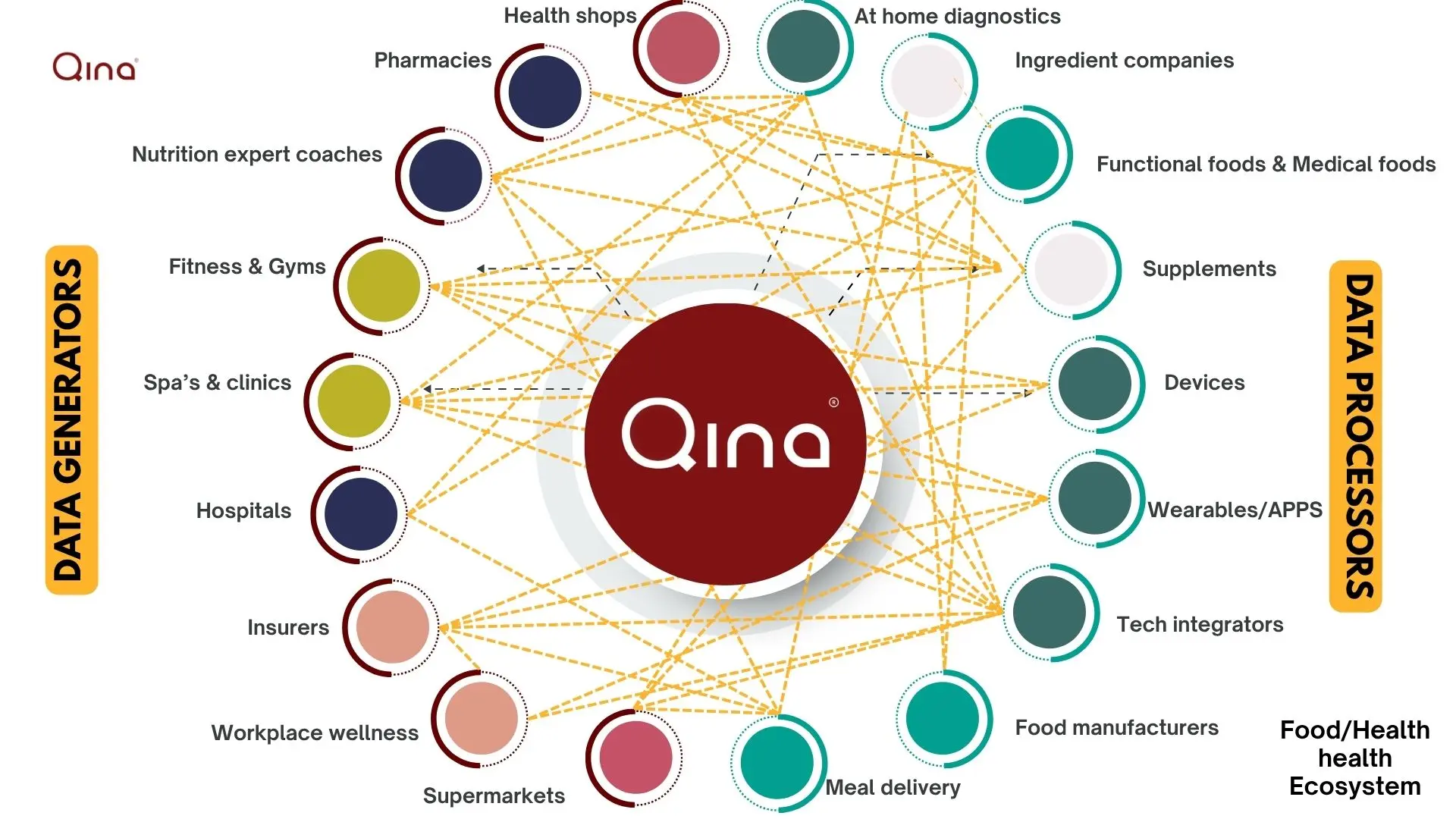
It is clear that there is ample overlap between companies where they sell into. For example at-home diagnostic kits and devices can now be found at Spa and wellness centers provided by a healthcare professional as part of a remote care package.
Industry examples
The industry is certainly not short of examples of how this is playing out in the marketplace
Foodsmart - offers education, foodscripts and access to telehealth services
Instacart - Offers online shopping targeted at specific chronic conditions
Cara Care - Offers a digestive tracking app recommended by pharmacies
Signos - Offers the first FDA approved CGM -AI paired solution for weight management
Danone - launched Oikos Fusion aimed at GLP-1 users in retail stores
What does this mean for Health & Nutrition Innovation?
The time has come to review how the innovation processes are approached internally. Innovation needs to be faster, lean, based on reliable data and feedback loops. It will be impossible to do continue with a "business as usual" approach when the risk of being left behind is growing by the day.
Why should executives care?
The ROI of nutrition intervention have always been contested, yet the voices are getting louder. The ROI of nutrition is around $3 for every $1 spent. A recent Rockefeller Foundation report found that Food as medicine programs could generate $45 million in economic activity and cut $32.1 billion in healthcare costs while preventing millions of hospitalizations each year. Understanding the good food can lead to better health has made consumers more aware of the importance of nutrient density, the role of fiber to improve gut health to name just a few examples. Consumers are increasingly prioritising heir health and are starting to vote with their wallets. Brands that do not lean into the health & wellness will miss out. With technological advances such as generative AI, it has become easier for consumers to find, compare and purchase brands that align with their beliefs and values. If brands cannot clearly demonstrate immediate fit, they will move down the priority list no matter how great marketing language is.
The Qina take - What should brands and companies do?
There are ways for executives, directors and C-Suite to keep pace with change across the industry.
- Competitive landscape - The industry is shifting continuously, this means keeping up with new innovations, science, partnerships and developments across food and health. Understand how your brand or solutions fits on the spectrum from prevention to medical nutrition
- Consumer behavior - Mainstream consumers are not yet tracking every data point there exists. However, consumers are increasingly seeking how to optimize their health. Understanding which consumer type you are addressing is key. There is an urgent need to go beyond Behavioral personas and actually demonstrate efficacy.
- Partnerships - Find partners within the ecosystem that can be paired with a solution to satisfy user need to perform the behavior
- Research - Doing research is not a nice to have, it is essential to demonstrate efficacy and should support and align with the business strategy.
- Data strategy - Carefully consider whether your company is collecting the right data to answer the problems that consumers are trying to solve.
How Qina can help
We are all about leveraging the latest in science and innovations to help companies and brands expand how they think about innovation.
We help companies with:
- Generating new product ideas, positioning and messaging
- Generating the data necessary to help consumers solve their problems through real world research
- Aligning teams to a shared strategy
- Understanding what is happening in the market and why with our market intelligence platform
To learn more about our services, click here, or sign up for free monthly updates to stay up to date on how the Food Health ecosystem evolves.
Conclusion
The Food Health ecosystem is complex and it is about to become increasingly complex with pharma, wellness and agrifood sectors also entering this industry. The opportunities remain plenty, but so far demonstrating societal impact is still lagging behind.
Reference:
1. https://www.rockefellerfoundation.org/reports/from-farm-to-fim-the-economic-impact-of-local-food-is-medicine/